
Log Home Restoration · Teton County, Wyoming & Idaho
Log Home Thermal Imaging in Jackson Hole and Teton Valley
Rot in a log wall starts on the inside, and by the time it shows on the surface you are replacing logs instead of sealing a joint. A thermal scan finds the wet log while the repair is still a day’s work.
- Wyoming corporation since 2008
- Idaho contractor RCE-35328, active
- BBB accredited, A+ rating
- Shop in Victor, Idaho

The short answer
What is log home thermal imaging?
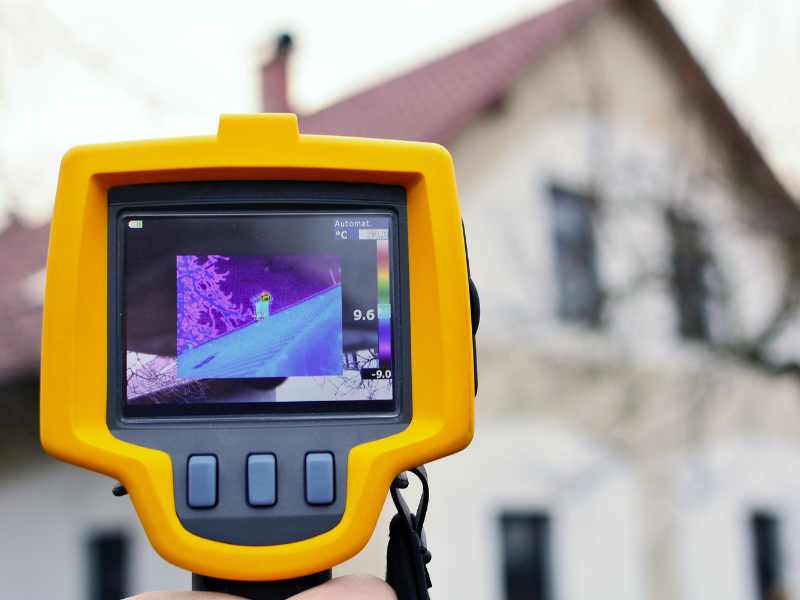
Log home thermal imaging is an infrared inspection that reads surface temperature across log walls, joints and roof lines. The camera does not see moisture or rot directly. It shows temperature differences caused by wet wood, air leaking through settled joints, and missing insulation, which a technician then confirms with a moisture meter.
Wet wood behaves differently from dry wood. It holds heat longer, and when it evaporates into dry air it cools the surface above it. Either pattern shows up as a shape that does not belong on the wall. A stain streak is cosmetic. A cold plume under a window buck is not.
The camera is a search tool. It narrows a whole elevation down to the few places worth opening or probing. Nothing should be called wet on a thermal image alone.
Moisture you cannot see
Six signs your log walls are holding water
Log homes rarely leak where they look wet. Water tracks down checks, along butt joints and behind trim, then sits in the log below. These are the conditions that put a moisture inspection on the calendar.
Checks that face the sky
A check is a split that opens as a log dries. The ones that face up collect rain and snowmelt and hold it against the heartwood. The surface looks fine. Wood held above twenty percent moisture supports decay fungi, and an open check keeps it there for months at a time.
Stain failing on one elevation
South and west walls take the sun and the weather. If the finish is chalking or peeling on those walls and holding everywhere else, the logs underneath have been wetting and drying on a cycle. That is the wall to scan first, and usually the wall where a soft log turns up.
Chinking pulled off the log
Chinking bonds to two log faces and stretches between them. Logs move. When a bead tears loose on one side, the gap behind it becomes a funnel that runs water into the joint and out of sight. From the ground it reads as a hairline. On a scan it reads as a stripe.
Cold rooms and high heating bills
Log walls should not be drafty. A settled home leaks at the joints, around window and door bucks, and at the top log where the roof meets the wall. Those leaks push warm indoor air into the assembly all winter. Air leakage and moisture damage are usually the same problem.
Ice dams above a stained log
Ice dams mean heat is escaping into the roof and melting snow above a cold eave. The meltwater goes somewhere. On a log home it commonly runs behind the fascia and into the top course of logs, where nothing dries out until June. Scan the wall, not only the roof.
Log ends and posts near grade
Log ends pull water through exposed end grain faster than any other surface on the building. Add splash off a deck, a sprinkler head aimed wrong, or grade that crept up over thirty years, and the bottom courses stay wet. These are the ones that turn into log replacement.
How the scan runs
How a thermal scan on a log home is actually run
A useful scan is not a walk-through with a camera. It depends on temperature difference, sun angle, wind, and a moisture meter in the technician’s other hand. Conditions decide whether the scan is worth doing that day.
- 01
Confirm the temperature difference
Published practice for building thermography calls for at least an eighteen degree Fahrenheit difference between inside and outside, held for three hours before the camera comes out. Below that the wall goes flat and defects hide. In Teton County that puts most useful scans between October and April, or on a cold clear morning in the shoulder season.
- 02
Scan away from the sun
Sun on a log wall ruins the image. Logs are massive, and mass holds heat, so an elevation that took afternoon sun stays warm long after the sun is off it. Exterior work happens before dawn or well after sunset. Wind does the same damage by stripping surface temperature off the wall before the camera can read it.
- 03
Work the inside first
The interior scan is the one that finds things. Every wall gets covered floor to ceiling, plus window and door surrounds, the top log, the loft, and the underside of the roof deck. Wet wood and air leaks both read on the interior surface, where the log sits closest to conditioned air.
- 04
Pull the house with a blower door
A blower door depressurizes the home, commonly to fifty pascals, roughly a twenty mile per hour wind on every surface at once. Joints that were invisible open up as cold streaks at bucks and butt seams. The insulation pass is shot before the fan runs, because moving air erases the pattern it would otherwise show.
- 05
Verify every finding with a meter
A thermal image is a temperature map, not a moisture reading. Wet wood can read cool from evaporation or warm from stored heat, and either can be misread. Suspect areas get pin or pinless moisture readings. Above twenty percent, decay fungi can live in the wood. Near thirty percent, decay is usually already established.
- 06
A report you can act on
The deliverable is a set of paired images, thermal beside visible, with location, moisture readings, and a plain description of what each anomaly is likely to be. Anything that needs a log opened is called out on its own. An absentee owner should be able to approve the work from the report alone.
What it costs
Thermal imaging inspection cost in Jackson Hole and Teton Valley
Residential infrared scans run roughly $300 to $700 nationally, and $200 to $450 for a blower door on its own. Jackson Hole and Teton Valley price above national rates. Plan on $450 to $1,200 for a log home, more with a blower door and a full report.
Estimated scan pricing, Teton region
- Targeted scan, one problem area$250 – $500
- Full log shell thermal scan$450 – $900
- Blower door test, single-family home$250 – $550
- Blower door and infrared together$600 – $1,400
- Written report with paired images$100 – $250
- Return scan after repairs$200 – $450
A cheap scan is a walk-through in the wrong conditions with no meter and no written report. It finds nothing, and you conclude the wall is fine. The cost of that is not the difference in the invoice. It is four logs replaced in three years instead of one joint sealed this fall.
Get the wall scanned before you open it
Call Log Care at 307-734-9563. Tell us what you are seeing and where. If a scan is the right tool for it, we will tell you what conditions we need and when to schedule it.
Questions we get asked
Log home thermal imaging questions
Can thermal imaging find rot inside a log wall?
Indirectly, and that distinction matters. The camera reads surface temperature, not decay. Active rot is wet, and wet wood holds and releases heat differently than the log beside it, so it shows up as an anomaly. Rot that dried out years ago may show nothing at all. Every flagged area gets a moisture meter and often a probe before anyone calls it rot.
What time of year should a log home be scanned?
Heating season. A useful building scan needs roughly an eighteen degree difference between inside and outside temperature, held for about three hours before the camera comes out. In Teton County and Teton Valley that is reliably late October through April. Summer scans are possible before sunrise after a cold night, but the signal is weaker and more defects get missed.
How much does a thermal imaging inspection cost in Jackson?
Published rates for residential infrared scans run about three hundred to seven hundred dollars, with blower door testing adding two to five hundred more. Jackson Hole prices above national averages, so budget four hundred fifty to twelve hundred for a log home, and more for a large shell with a blower door. Those figures are market research, not a Log Care quote. Call for a number on your house.
Do I need a blower door with the scan?
If the question is moisture, usually not. If the question is why the house is cold and the propane bill is high, yes. A blower door pulls the home to about fifty pascals, roughly a twenty mile per hour wind on every surface at once, and settled log joints that were invisible turn into visible cold streaks. The insulation pass is shot before the fan starts.
Can you scan my log home while I am out of state?
Yes. Most scheduling here goes through caretakers and property managers, and the owner is usually somewhere else. What we need is interior access, power, and the heat running so there is a temperature difference to read. The report is built to be read cold, with thermal and visible photos side by side and every location named, so you can approve work without standing in the room.
How is a thermal scan different from a log home inspection?
A log home inspection is a person on a ladder with a probe and a moisture meter, working elevation by elevation. A thermal scan is one instrument added to that work. It covers a whole wall in seconds and flags places a probe would never think to check. It does not replace hands-on inspection, and no honest technician will tell you it does. Use both.
Keep reading
Related services
Log Rot & Log Replacement
What we do when the scan finds a soft log. Cut out the decay, splice in new.
Read moreChinking & Caulking
The repair for most of the air leaks and water paths a thermal scan turns up.
Read moreStaining & Refinishing
Finish failure is where the water gets in. Stain is the first line of defense.
Read more