
Interior & Exterior Painting · Teton County
House Painting in Jackson Hole and Teton Valley
Paint belongs on your fascia, your soffit, your doors, your dormers and every interior wall. It does not belong on your logs. Log Care paints the parts of a log home that should be painted, and tells you plainly which parts should not be.
- Wyoming corporation since June 2008
- BBB accredited with an A+ rating
- Idaho registration RCE-35328, active
- Shop in Victor, Idaho

The short answer
Should you paint a log home?
No. You should not paint a log home. Paint forms a film on the wood surface that blocks moisture vapor from leaving the log. The log absorbs water, cannot dry outward, and rots from the inside while the paint still looks intact. Logs need a breathable penetrating stain, not a film-forming coating.
The failure hides. Water gets behind the film through a check, a nail hole, or an unsealed end grain, and then it cannot get back out. Two or three years later the paint blisters. By the time it peels, the log behind it is soft. Getting paint back off logs is one of the most expensive jobs in this trade.
That is the answer for the log walls. It is not the answer for the house. Every log home in Jackson Hole has painted surfaces — fascia, soffit, trim, doors, dormers, metal, and every interior room that is not log. That work is real, and it is better done by a crew that already understands how the envelope behaves.
What we do paint
What actually gets painted on a log or timber home
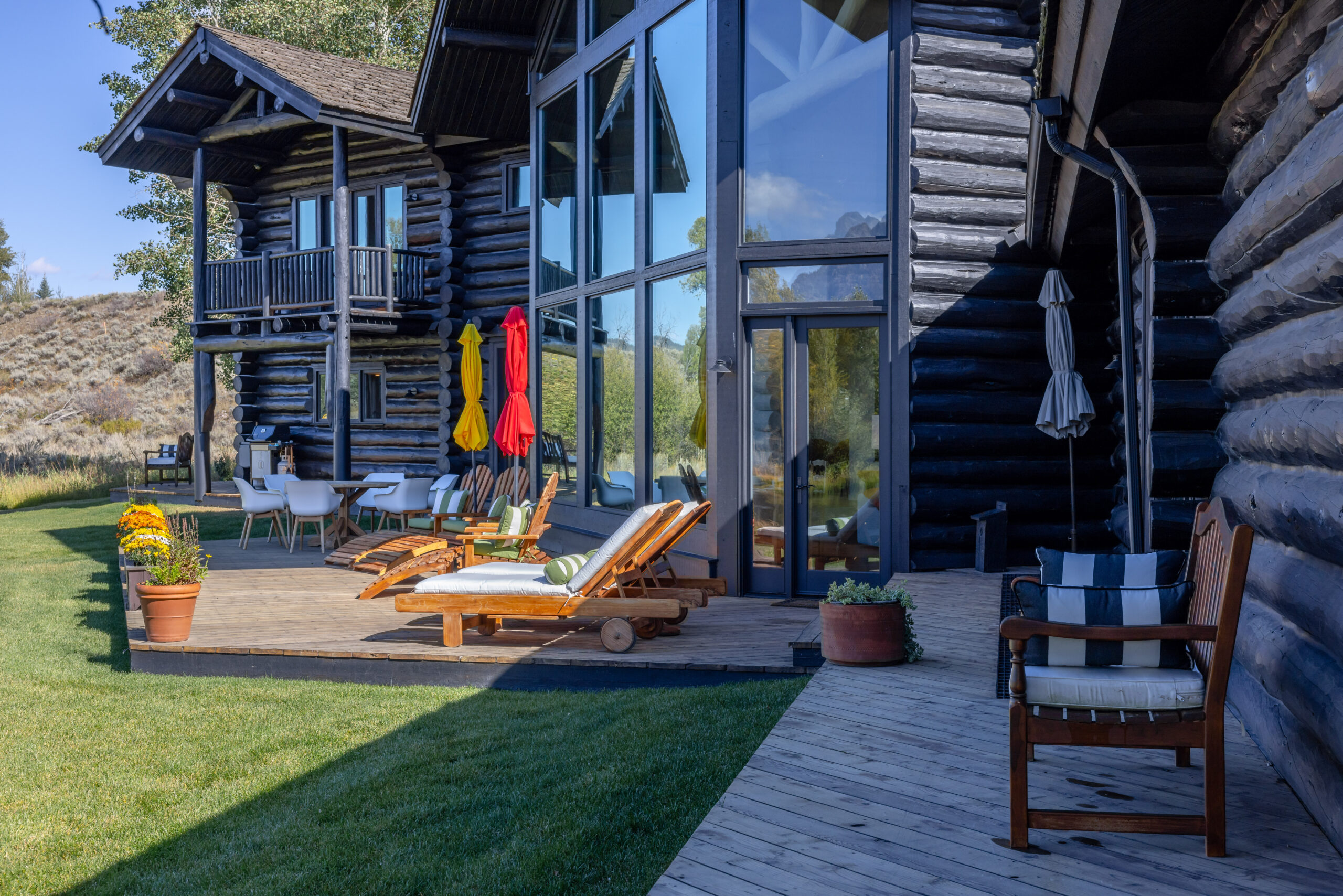
Every log home has painted surfaces. Fascia, soffit, rake boards, window trim, entry and garage doors, dormer and addition siding, metal railing, and every interior drywall wall and ceiling. On most homes that is a few thousand square feet of paintable surface.
Fascia, soffit and rake
These take the worst of it. Fascia sits at the drip edge and catches the runoff. Soffit stays shaded and slow to dry. Rake boards face straight into afternoon sun. Most exterior coating failures on a log home start on one of these three, not on the logs.
Window and door trim
Trim moves. It is dimensioned lumber, so it swells and shrinks across the grain far more than a log does, and the joints open. Caulk usually fails before the paint does. Failed sealant gets cut out, the joints get resealed, and every bare spot gets primed before a finish coat goes on.
Entry doors and garage doors
A south-facing entry door at this elevation is the hardest square footage on the building. Direct sun, reflected glare off snow, and a forty-degree swing between afternoon and dawn. Doors usually need their own schedule, often a different coating than the trim around them, and more frequent recoats.
Dormers, additions and gables
Plenty of log homes in Teton Valley have conventional framed sections — a dormer, an attached garage, a later addition in lap or board-and-batten siding. That siding is paintable and usually should be painted. It is also where two building systems meet, which is where water finds its way in.
Metal railing and steel
Deck railing, stair stringers, chimney chase caps and exposed structural steel all rust here. Freeze-thaw and winter road treatment do the rest. Metal needs mechanical prep back to sound substrate and a primer built for it. Wood primer on steel is a two-year job at best.
Interior walls, trim and ceilings
Almost every log home has drywall inside — bedrooms, baths, hallways, the whole lower level. Interior work has no weather window, so it is what can run in February. Cutting a clean line where painted drywall meets a log wall or an exposed timber is its own skill.
How it holds up
How exterior paint is made to last at 6,000 feet
Paint at 6,000 feet fails from the top down. Ultraviolet breaks the binder, the film cracks, then water gets in and freezes. Longevity comes from prep, primer, and coating inside a narrow temperature window — not from the price of the paint.
- 01
Wash first, then read the wood
Everything gets washed before anything gets judged. Under the dirt you find the real condition: chalked binder, open joints, soft fascia returns, black staining where the soffit stayed wet. Moisture content gets checked before a schedule is set. Wood sitting above roughly fifteen percent does not get painted. It gets dried.
- 02
Take failed coating back to sound
Feathering into a failing film buys you one season. Anywhere the old coating has lost adhesion comes off — scraper, carbide, sander or media, depending on the substrate. The line between what stays and what goes is set by whether the film is still bonded, not by how much work removal will be.
- 03
Repair the wood before it gets coated
Paint does not fix rot. It hides it. Soft fascia, punky trim ends, split rake boards and open nail holes get repaired or replaced first. On a log home the same trade handles that carpentry, so the repair matches the building instead of reading as a patch that somebody painted over.
- 04
Prime six sides, seal the end grain
End grain absorbs water many times faster than face grain. Any new board goes up primed on all six sides, with the cut ends sealed before it is fastened. Back-priming is the step most often skipped, and it is why replacement trim on a mountain home fails again in four years.
- 05
Match the primer to the substrate
Cedar and redwood bleed tannin through a waterborne primer and stain it brown. Bare weathered wood, galvanized metal and previously coated surfaces each want something different. The primer decides whether the finish coat holds. Choosing one primer for the whole house is how a job fails in patches.
- 06
Coat inside the window
Jackson runs about seventy-eight degrees in the afternoon and forty-three overnight in July. Most coatings need the surface above fifty degrees and more than five degrees above the dew point, and they need it to stay there while they cure. That is a short list of usable hours, and it runs out in September.
What it costs
What house painting costs in Teton County and Teton Valley
Exterior trim and door packages on a log home here generally run four thousand to fourteen thousand dollars. A whole-house interior repaint runs higher. Labor carries a resort-market premium, and the short season means crews cannot spread the work across ten months.
Painting ranges, Teton County
- Fascia, soffit and exterior trim, whole house$4,000 – $14,000
- Entry or garage door, per opening$350 – $1,200
- Painted siding on dormers and additions$4 – $9 / sq ft
- Metal railing, prepped and recoated$35 – $90 / linear ft
- Interior repaint, 3,000 sq ft home$12,000 – $30,000
- Stripping paint off log walls, then restaining$20 – $40 / sq ft
The cheap bid is cheap because prep was cut. Nobody sees prep, and prep is the only part of a paint job that decides how long it lasts. A four-year finish on a house that needs staging and a lift costs more over twelve years than a twelve-year finish did up front.
Talk to Log Care about your painting
Call 307-734-9563 or send us the address. We will walk the building, tell you what should be painted and what should be stained, and put the scope in writing before anyone quotes a number.
Questions we get asked
House painting questions
A previous owner painted our log walls. What are our options?
Two. Leave it and keep recoating a film that will go on trapping moisture, or take it off and go back to a breathable penetrating stain. Removal usually means media blasting, because chemical strippers will not reach into log checks and corners. Once the paint is off, the logs get inspected, any rot gets cut out and replaced, and the wall gets stained. It is expensive and it is permanent. Recoating paint is neither.
What is the difference between paint and stain on a log home?
Paint sits on top of the wood as a continuous film. Stain penetrates into it. A log takes on and gives off moisture with the seasons, and it has to release that moisture through its outer surface. A penetrating stain lets it. A paint film does not, so the moisture stays in the log and the log rots while the surface still looks fine. On trim, siding and doors, a film is exactly what you want.
When can you paint outside in Teton County?
Roughly late May through mid-September, and both edges of that are weather-dependent. Most exterior coatings need the surface above fifty degrees and more than five degrees above the dew point, during application and while they cure. Jackson averages overnight lows in the low forties even in July. Early morning starts are often too cold and late-day coats can chill before they film. Exterior work books early here, and interior work fills the winter.
How long does exterior paint last at this elevation?
Less than the label says. Ultraviolet intensity climbs with altitude, and a home at six thousand feet takes on the order of a quarter more ultraviolet than the same home at sea level. South and west exposures show it first: fading, then chalking, then cracking. On a properly prepped surface, expect roughly seven to ten years on sheltered elevations and four to six on the sun side. Bad prep halves all of those numbers.
Do you paint interiors, or only exteriors?
Both. Interior work means drywall, ceilings, trim, doors and cabinetry in the framed portions of a log home, plus the cut lines where painted drywall meets a log wall or an exposed timber. Interiors have no weather window, so that work runs through the winter after exterior painting has stopped for the year. If the house is seasonal, interior work is usually the easier scope to schedule around an empty building.
We live out of state. Who manages the job?
Many homes here are second or third properties, and the scheduling often runs through a caretaker or a property manager. We will work with whoever you designate. What matters is that the scope, the exposures being coated and the sequence are in writing before work starts, so an approval given from another state is given against the same document the crew is working from.
Keep reading
Related services
Staining & Refinishing
The right system for log walls — penetrating stain that lets the wood release moisture.
Read moreMedia Blasting
How failed paint and old finish come off logs without gouging the wood underneath.
Read moreCarpentry
Fascia, soffit, trim and rake boards get repaired or replaced before anything is coated.
Read more