
Log Home Media Blasting in Jackson Hole
- Serving Teton County since 2008
- Licensed & insured crews
- Free on-site assessment
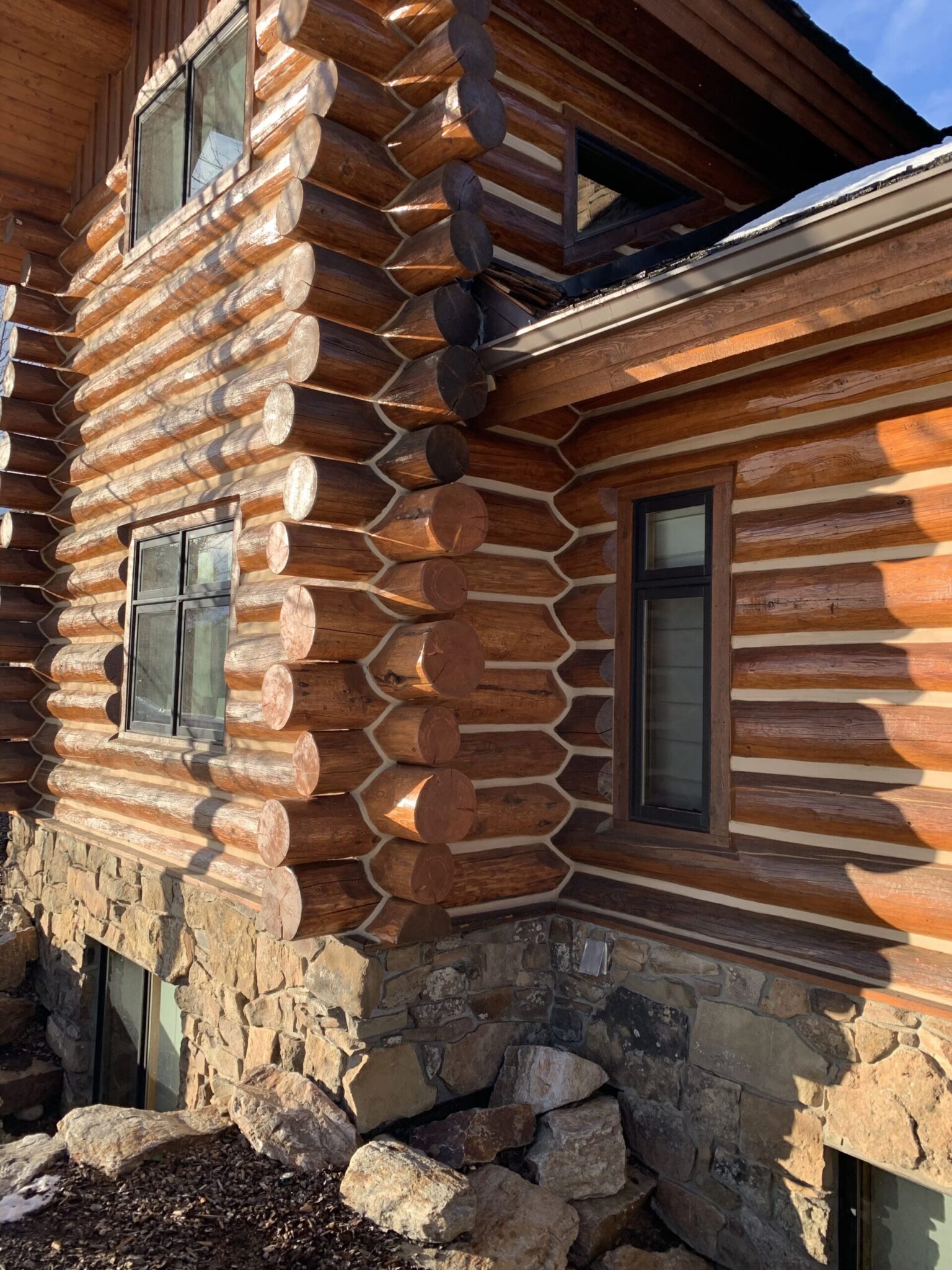
What is log home media blasting?
Log home media blasting is the controlled removal of a failed finish using a soft abrasive — crushed walnut shell, corn cob, glass, or soda — propelled at low pressure. It lifts old stain, mill glaze, and gray oxidised fiber off the log and stops at sound wood, leaving a clean, open surface that new sealant and stain can actually bond to.
The word most people reach for is sandblasting, and it is the wrong tool for a log wall. Silica sand is hard, sharp, and indiscriminate. It carves into soft spring wood while barely touching the harder grain, so you end up with a rippled, furry surface, raised grain, and abrasive driven into the timber. On a house you intend to stain, that is damage you then pay to repair.
Media blasting solves the same problem by matching the abrasive to the coating being removed and the wood underneath it. Done correctly it is faster than chemical stripping, gentler than sanding, and it reaches the checks, corners, and log ends a sander never will.
Which abrasive, and when
The media is the whole decision in log home media blasting. Too soft and you spend three days not removing a finish. Too hard and you damage the wood you are trying to save. What we run depends on the coating, the species, and the condition of the log underneath.
| Media | Best for | Aggressiveness | Watch out for |
|---|---|---|---|
| Crushed walnut shell | Failed film-forming stain on sound wood. The workhorse for most Teton County restorations. | Low to moderate | Slower on heavy multi-coat build-up. |
| Corn cob | Light oxidation, mill glaze, and prepping wood still in good condition. | Low | Struggles with thick elastomeric coatings. |
| Crushed glass | Heavy, stubborn coatings and badly weathered gray fiber. | Moderate to high | Will raise grain if the operator pushes pressure. Skill-dependent. |
| Sodium bicarbonate | Delicate or historic logs, and interior work where dust control matters. | Very low | Residue must be neutralised or it interferes with stain adhesion. |
| Dry ice | Interiors, smoke and mould remediation, no secondary waste to clean up. | Low | Expensive, and slow on exterior finish removal. |
| Silica sand | Nothing on a log home. | Destructive | Gouges soft grain, embeds in the wood, and carries a serious respirable-silica hazard. |
Pressure matters as much as media. The same crushed glass that cleans a wall beautifully at the right pressure will wreck it at the wrong one. Ask any contractor what media and what pressure they intend to run on your species of log. A vague answer is the answer. The USDA Forest Products Laboratory Wood Handbook documents why surface fiber condition, not the coating alone, governs how long a finish lasts on exterior wood.
Six signs your logs need blasting
Log home media blasting is prep, not decoration. You need it when the existing finish can no longer be recoated — which is usually two or three years before anyone calls.
The stain is peeling or flaking
A film-forming finish that has lost adhesion cannot be recoated. Anything applied over it fails with it.
The wood has gone gray or silver
Gray is dead, UV-destroyed fiber. Stain will soak into it and still fail, because there is nothing sound underneath to hold on.
Black streaking or mildew
Surface fungus feeds on the failed coating. It has to come off, not be sealed under a new coat.
Previous coats are stacked up
Multiple layers of old stain trap moisture in the log. Removal is the only correct answer.
Somebody painted it
Paint on logs is a moisture trap and a rot accelerator. Removal is not optional — see why you should never paint a log home.
Mill glaze on a newer home
New logs come with a compressed, sealed surface from the milling process. Stain will not penetrate it. Light blasting opens the grain.
Our log home media blasting process
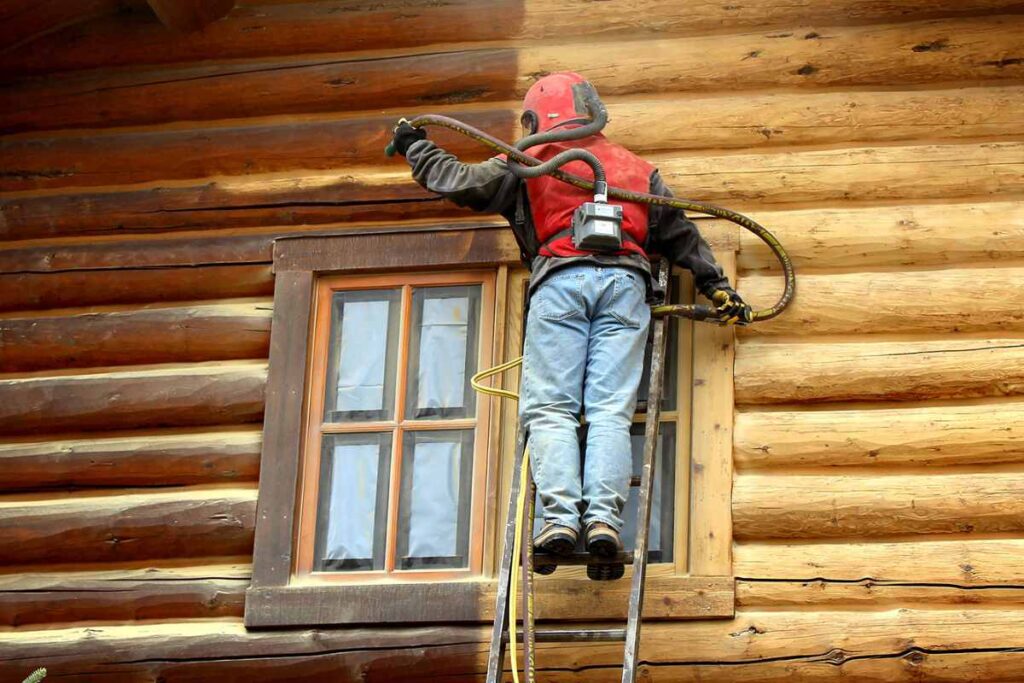
Blasting a log home is not a one-day job with a rented pot. Containment, media choice, and what happens in the 48 hours after the last pass are what separate a wall that takes stain evenly from one that blotches.
Containment is also a compliance issue. Crushed glass and silica-bearing media fall under the OSHA respirable crystalline silica standard, which is one reason we run walnut shell and glass on residential log work and keep the site tarped and monitored.
- 01
Assessment and test patch
We blast a small, inconspicuous area first to confirm the media and pressure on your actual logs. Species, age, and coating history all change the answer, and a test patch costs an hour instead of a wall.
- 02
Containment and protection
Windows, doors, roofing, landscaping, and mechanicals get masked and covered. Media travels further than people expect, and cleanup is part of the job, not an afterthought.
- 03
Blasting, elevation by elevation
Consistent standoff distance and pressure, worked systematically so there are no missed patches and no over-blasted soft spots. South and west walls usually need more passes than the sheltered sides.
- 04
Detail work
Checks, corner notches, log ends, and under the eaves — the places a nozzle has to be worked deliberately and a sander cannot reach at all.
- 05
Inspection for rot and damage
Blasting exposes everything the old finish was hiding. Soft wood found now becomes log rot repair before anything gets sealed over it.
- 06
Cleanup, borate, and stain window
Full site cleanup, then borate treatment where it is warranted, then stain inside the correct moisture window. Bare logs left open too long start oxidising again.
What log home media blasting costs in Teton County
Blasting is priced by the square foot of log surface, not by the square foot of house. In Teton County it runs $3 to $6 per square foot. A typical log home here carries 2,800 to 4,200 square feet of exterior log surface, which puts most whole-house projects between $9,000 and $26,000. Coating type, media choice, and access are what move a quote most.
Blasting is almost never bought alone. It is the prep stage for staining, and often for chinking and rot repair found once the wall is bare. Priced together, the mobilisation and containment are paid for once instead of three times.
What moves your number
Every one of these is measurable on a site visit. None of them is a guess.
- Square footage of log surfaceMeasured off the actual wall area including gables and dormers, not derived from the home's floor plan.
- Coating being removedA single failed oil stain comes off fast. Four stacked coats, or paint, is a different job entirely.
- Media requiredWalnut shell and corn cob cost less to run than glass or dry ice. The coating decides, not the budget.
- Log profileHand-hewn, full-scribe, and heavily checked logs take far longer than uniform milled D-logs.
- ContainmentTight lot lines, neighbouring properties, water features, and mature landscaping all add masking time.
- Access and heightTwo or three stories over a walkout means lifts or scaffolding, and that goes on the invoice.
- Rot found once bareBlasting exposes what the old finish hid. Budget a contingency; it is cheaper than discovering it mid-project.
- SeasonBare logs cannot sit open indefinitely. Late-season blasting carries real risk of missing the stain window.
We put the number in writing after a site visit, itemised by elevation, so you can see what is prep, what is repair, and what can wait a season.
Ranges are typical for Teton County and Teton Valley. Every log home is priced from a site visit, because access, wall height, log condition and the finish coming off change the number.
forty years of stain.
Log home media blasting questions we get asked
Is media blasting the same as sandblasting?
No, and the difference matters. Sandblasting uses hard silica sand that gouges soft grain, raises the wood fiber, and embeds abrasive in the log. Media blasting uses a soft abrasive matched to the coating — walnut shell, corn cob, glass, or soda — at low pressure, so it removes the finish and stops at sound wood.
Will log home media blasting damage my logs?
Not when the media and pressure are matched to the wood. Damage comes from using sand, running pressure too high, or holding the nozzle too close. Ask for a test patch before the crew starts a full elevation — any competent contractor will do one.
How long does it take?
For a typical Teton County log home, the blasting itself is usually three to six working days depending on square footage, coating, and access. Containment and setup add a day on either end, and the stain has to follow inside the correct moisture window.
Do I have to stain right after blasting?
Yes, and soon. Bare logs start oxidising again within weeks of being exposed. Blasting and staining should be scheduled as one project, not two — otherwise you pay to blast the same wall twice.
Can you blast a log home that has been painted?
Yes, and it usually has to be. Paint traps moisture against the log and accelerates rot. Removal is heavier work than stripping stain and it prices accordingly, but leaving it is the more expensive choice.
What about the mess?
Media travels. Containment, masking, and full site cleanup are part of a professional log home media blasting job and should be written into the scope. If a quote does not mention cleanup, ask why.
Related services
Staining & Refinishing
Bare logs oxidise within weeks. Blasting and stain are one project scheduled together, never two.
Staining Often togetherChinking & Caulking
With the wall bare, joints are accessible and clean. It is the cheapest time you will ever re-chink.
Chinking Found once bareLog Home Repair
Blasting exposes what the old finish was hiding. Soft wood gets repaired before anything is sealed over it.
Log rot repair