
Window Washing · Teton County, Wyoming & Idaho
Window Washing for Log and Timber Homes in Jackson Hole
The glass on a Teton County log home is the most expensive surface on the building and the easiest one to ruin permanently. Hard water etches it. Razor blades scratch it. At this elevation most of these homes need washing twice a year, and the high glass is the part nobody wants to touch.
- Wyoming corporation since June 2008
- BBB accredited, A+ rating
- Idaho registration RCE-35328, active
- Shop in Victor, Idaho
The short answer
What does window washing on a log home include?
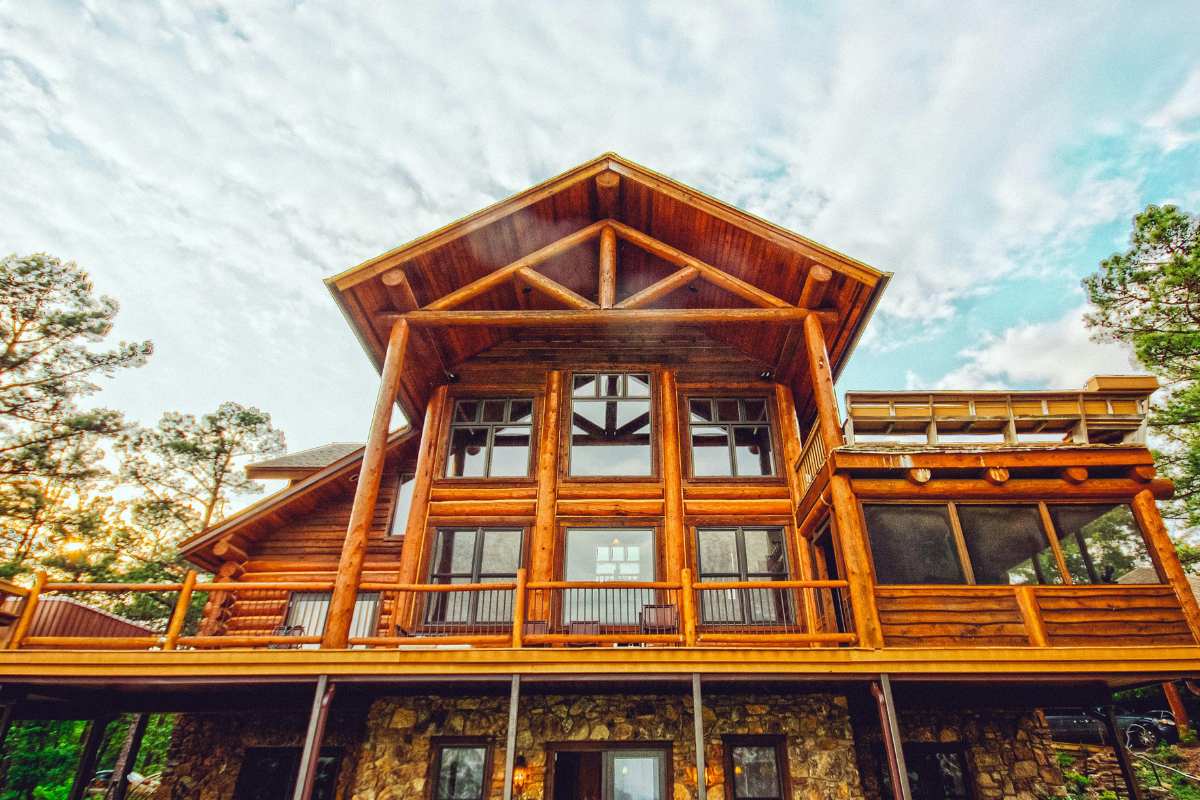
Window washing on a log or timber home is exterior and interior glass cleaning on units that are often oversized, fixed, and set two or three stories up in a gable wall. The work includes screens, tracks and sills, and removal of mineral deposits, pollen film and construction residue that ordinary washing leaves behind.
The glass is what makes it different. A production window cleaner prices a house by counting standard double-hungs. A log or timber home in Teton Village or on a bench above Driggs has fixed picture units eight feet tall, gable glass thirty feet up, and nowhere to foot a ladder because the grade falls away into rock. The pane count is low. The work is not.
The other half is what has already happened to the glass. Irrigation overspray. A refinishing job masked in a hurry. Fifteen winters of sand off the county road. Some of that washes off. Some of it has to be polished out, and Log Care would rather tell you which is which before the invoice than after.
What goes wrong
What actually damages the glass on these homes
Most permanent glass damage on a mountain home comes from four sources: irrigation overspray, razor blades on tempered glass, the wrong cleaner on a room-side low-E coating, and finish overspray left to cure. All four are avoidable. None of them are reversible with a bucket and a squeegee.
Sprinkler overspray etches the glass
Irrigation water carries calcium and magnesium. Every cycle wets the glass and evaporates, leaving minerals behind. Over months the silica in those deposits bonds chemically to the glass surface. High-altitude UV bakes it in faster. Past that point no cleaner touches it. The surface has to be polished.
Razor blades on tempered glass
Tempered glass can carry fabricating debris, fine glass particles fused into the surface during manufacture. A scraper catches those particles and drags them, and the panel comes out scratched. The defect was there before anyone showed up. The blade is what reveals it.
Room-side low-E coatings
Newer high-performance units put a low-E coating on surface four, the interior face of the inside pane. It adds roughly twenty percent to the unit’s insulating value. Manufacturers say it plainly: no razor blades, no steel wool, no metallic pads. Ammonia and alcohol cleaners are not recommended either.
Stain and finish overspray
Log finish that lands on glass and cures is a different problem than a dust film. It comes off with solvent, dwell time and a plastic blade, worked from the edge, tested in a corner first, and never with steel on a coated pane. Rushing this step is how panels get replaced.
Ladders on a great-room wall
Two-story gable glass sits above a deck, a rock apron or a slope. There is nowhere level to foot a ladder, and the panel is a foot from the ladder rail. This is where crews fall and where glass gets broken. It is also where cheap bids quietly skip the work.
Pollen, smoke and snowmelt grit
Pine pollen coats glass in a yellow film through late spring. Wildfire smoke leaves a fine soot haze through August and September. Snowmelt throws sand and cinder onto lower panes all winter. Each load is different, and washing during peak pollen buys you about a week.
How the work runs
How a window washing visit on your property runs
A window wash on a log home starts with a walk, not a bucket. We count the openings, find the access problem, work out what is coating and what is deposit, and document existing damage before anything gets touched. Then the glass gets sorted into clean and restore.
- 01
Walk the house before anything gets wet
We count panes, not windows. A divided-light unit with twelve lites is twelve pieces of work. We note where a ladder will and will not stand, check whether the units are tempered, and look for a room-side coating. Pre-existing scratches, failed seals and fogged units get flagged in writing before the first bucket comes off the truck.
- 02
Separate washing from restoration
Dirt, pollen and soot wash off. Bonded mineral does not. The test is simple. Wet the pane and look at it while it is wet. If the haze disappears under water it is surface film. If it stays, silica has bonded into the glass and that panel needs polishing, priced separately from the wash.
- 03
Settle the access before the date
Water-fed poles reach roughly thirty feet from the ground, and carbon fiber gets higher. Above that, or where the pole cannot get a clean angle on a raked gable, the job needs a lift and a place to put it. That decision changes the price and the schedule, so it gets made during the estimate, not on the morning of.
- 04
Deionized water outside, hand work inside
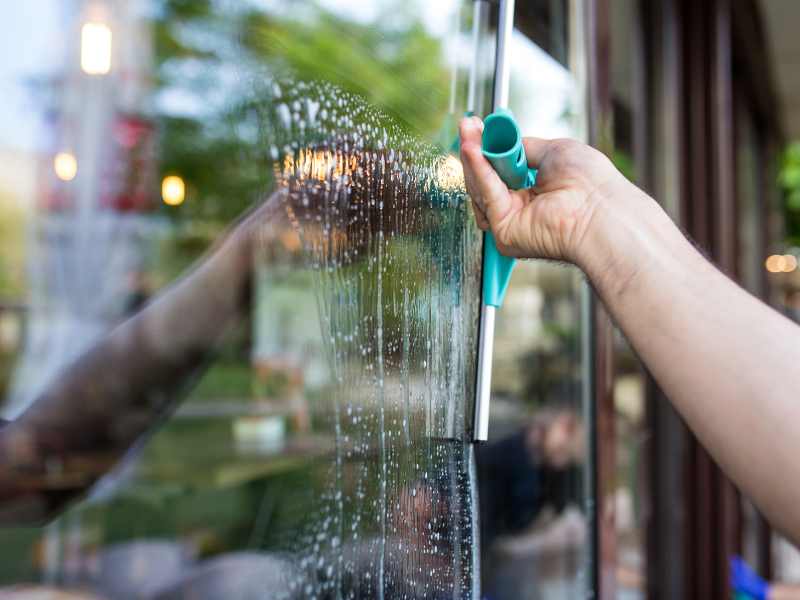
Purified water at zero dissolved solids lifts dirt and dries without a spot, because there is nothing in it to leave behind. No detergent means no film to attract the next round of dust. Interior glass is different. That is squeegee and towel work, close up, with the coating rules respected on every pane.
- 05
Screens, tracks and weep paths
Screens come out, get washed flat and go back in the opening they came from, because mountain homes rarely have two the same size. Tracks and sills get cleared of grit and needle litter. Weep holes get opened. A blocked weep path holds water against the sill, and on a log home that is how rot starts under a window.
- 06
Tell you what we saw up there
Nobody else gets that close to the top of your wall. From a lift at the gable peak you can see chalking stain, open checks, failed caulk at the window head and daylight through a chink line. That report is the part of a window wash that is actually worth money on a log home.
What it costs
What window washing costs in Jackson Hole and Teton Valley
National residential window cleaning runs about $4 to $8 per pane for one side and $8 to $16 for both. Teton County is not a national market. Adjusted for local labor and the access these homes demand, plan on $8 to $16 per reachable pane and $20 to $55 per pane on high gable glass.
Planning ranges, Teton region
- Exterior wash, ground-reachable pane$8 – $16
- High gable or great-room pane$20 – $55
- Screens, tracks and sills, per window$5 – $14
- Hard water restoration, per pane$35 – $120
- Whole-home exterior, large timber home$1,200 – $3,500
- Lift on site, added day rate$500 – $1,200
The cheap bid on a house like this is cheap because the high glass does not get done, or because it gets done from a ladder that should not be there. A scratched twelve-foot fixed panel is not a cleaning problem. It is a glazing invoice, and the crew that caused it is usually already off the property.
Get a real number for your glass
Call 307-734-9563. Tell us how many stories, how the ground sits under the big glass, and whether there is irrigation near the house. We will come look before we quote.
Questions we get asked
Window washing questions
How often should windows be washed at this elevation?
Twice a year is the floor for most homes in Teton County and Teton Valley, once after pollen season ends in late spring and once in early fall after the dust and smoke settle. Homes above about 6,500 feet, or with irrigation running near the walls, do better on three. Washing during peak pine pollen is wasted money; the glass is coated again inside two weeks.
Are hard water spots permanent, or can they come off?
Both, depending on how long they have been there. Fresh mineral comes off with an acidic cleaner. Once the silica in the deposit bonds to the glass, chemicals stop working. Acid dissolves the calcium and leaves the silica behind, and strong acid can etch the glass itself. Bonded staining comes off mechanically, with abrasive discs stepped down to a cerium oxide polish.
Will you scratch my windows?
The honest answer is that tempered glass carries a risk no cleaner fully controls. Fine glass particles can fuse to the surface during tempering, and any scraper that catches one drags it across the pane. That is why blades stay off tempered and coated glass unless there is no alternative, why a corner gets tested first, and why pre-existing scratches get documented before work starts rather than argued about after.
Do you wash the inside as well as the outside?
Interior and exterior are separate jobs and get priced separately. Exterior glass on a big timber home is mostly pole and lift work. Interior glass is hand work, squeegee and towel, on a ladder inside a great room over furniture and flooring. Many absentee owners have the exterior done twice a year and the interior once, timed before the family arrives.
We are out of state. Does someone need to be here?
Not for exterior work. A caretaker or property manager can let us onto the property, and everything outside happens without anyone in the house. Interior glass needs access, so that gets scheduled with whoever holds keys. Log Care runs out of a shop in Victor, Idaho and works both sides of the pass, which is why a lot of absentee owners keep one company on the property instead of four.
How do you reach glass thirty feet up in a great room gable?
From the ground where possible. A water-fed pole carries purified water up roughly thirty feet, and carbon fiber goes higher, so the operator stays on the ground and the glass dries without spotting. Above that reach, or where a raked gable blocks the angle, the job needs a lift with somewhere firm to set it. That gets decided during the estimate, because it changes both the price and the date.
Keep reading
Related services
Pressure Washing
Soft washing logs, decks and stone before the glass gets done, so the dirt only moves once.
Read moreStaining & Refinishing
What the crew is looking at from the lift while the windows get washed.
Read moreThermal Imaging
Finds failed window seals and air leaks the glass itself will never show you.
Read more