
Log Home Restoration · Teton County, Wyoming & Idaho
Log Home Repair in Jackson Hole
- Serving Teton County since 2008
- Licensed & insured crews
- Free on-site assessment
The short answer
What is log home repair?
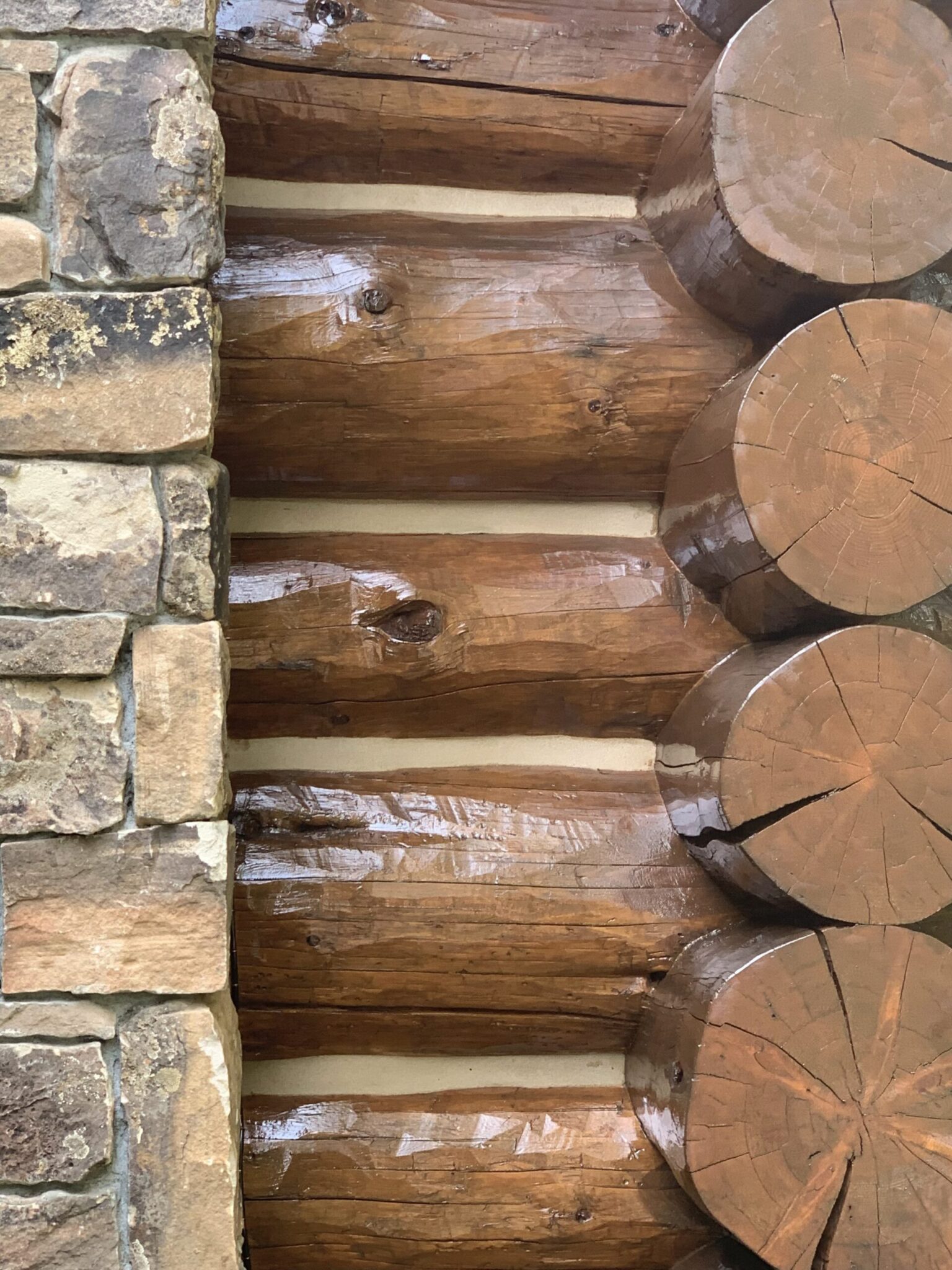
Log home repair is the removal of wood that has lost its structural integrity — to rot, insects, or long-term water exposure — and the replacement of it with sound timber, plus the correction of whatever let the water in. It ranges from a single Dutchman patch on a log end to jacking a wall and replacing a full sill log.
Most log home repair in Teton County is water damage wearing a different name. Wyoming and Idaho winters put snow against the bottom courses for months, spring melt saturates the grade line, and short overhangs let wind-driven rain reach walls that were never designed to shed it. Wood stays wet, decay fungi wake up above roughly 20 percent moisture content, and the log starts losing strength long before the surface looks bad.
That is the part homeowners miss. A log can be structurally compromised while the outside still holds stain. By the time the surface is soft or dark, the damage behind it is usually two to four times larger than what you can see. The repair is not the hard part — finding the true edge of the damage is.
Where log homes actually fail
Six places rot starts on a log home
Rot is not random. It shows up where water is held against wood long enough to stay above 20 percent moisture content, and on a log home that means six predictable places.
Sill logs and the first two courses
The bottom of the wall sits closest to grade, splash-back, and drifted snow. It is where the majority of serious log home repair starts, and where a failure is structural rather than cosmetic.
Log ends and crown checks
End grain drinks water at many times the rate of the side of a log. An upward-facing check on a projecting log end is a funnel pointed straight into the heartwood.
Under windows and doors
A failed sill pan or missing head flashing puts water behind the log instead of on it. The stain above the window still looks perfect while the log under the sill turns to punk.
Deck ledgers, rail posts and anything bolted through
Every fastener through a log is a path for water and a place it cannot dry. Rot around a deck ledger is common and dangerous, because the failure is in the connection carrying the load.
Roof-to-wall junctions and short overhangs
A log home with less than two feet of overhang is asking the wall to be a roof. Add a valley that dumps onto a corner and you get a repeating repair in the same three logs.
North and west elevations
North walls dry slowest. West walls take the weather and the worst UV. If only one elevation needs log home repair, it is almost always one of those two.
Diagnosis before demolition
How we decide what gets repaired and what gets replaced
The decision is depth, not appearance. We map how far the damage runs before anything is cut, because the cost difference between a patch and a full log replacement is an order of magnitude — and guessing wrong in either direction is expensive.
Four things happen on every assessment, in this order:
- 01
Probe the wood
An awl or probe into suspect areas at intervals. Sound wood resists. Compromised wood takes the probe with almost no pressure. This is crude, fast, and still the most reliable first read on a wall.
- 02
Meter the moisture
Pin and pinless moisture meters across the elevation, not just at the obvious spot. Anything holding above 20 percent is actively feeding decay. Readings also tell us whether the source is still live or whether the leak was fixed years ago.
- 03
Scan for what is hidden
Wet wood and voids read differently under a thermal camera than sound, dry log. It finds saturated areas behind trim, under flashing and inside corners that probing would miss. See thermal imaging.
- 04
Find the water source
Every repair that skips this step is a repair you pay for twice. Flashing, grade, gutters, overhang, deck attachment, sprinkler spray — the log did not fail on its own.
Five repairs, ranked by how far the damage runs
Log repair methods and when each one is honest
There are five real options for damaged logs, and they are not interchangeable. The right one is set by depth and by whether the log is carrying load — not by what is cheapest to quote.
| Method | Right when | Wrong when |
|---|---|---|
| Borate treatment | Wood is still sound but chronically damp, or you are protecting new timber before it goes in the wall. | Used as a cure. Borates stop decay organisms; they do not put strength back into wood that has already lost it. |
| Epoxy consolidation | Shallow, contained damage on a non-load-bearing surface — a soft log end, a checked crown — where you are rebuilding a profile. | Anywhere structural. Epoxy is harder than the wood around it, does not move with it, and traps moisture behind a shell that looks fine for years. |
| Dutchman patch | Localised damage under roughly a third of the log diameter. Sound wood is cut back square and a matched piece is let in and sealed. | Damage that runs deeper than it looks. A patch over live rot is a lid, not a repair. |
| Half-log & facing replacement | The outer face is gone but the interior half of the log is sound and still carrying load. Common on long walls where a full replacement is disproportionate. | The damage has reached the inside face, or the log is a sill carrying point loads. |
| Full log replacement | Rot has gone through the log, reached the notch, or the log is a sill or a course carrying the wall above. The wall is jacked, the log comes out, a matched log goes in. | Almost never wrong — only expensive. The mistake is doing it when a facing would have held. |
Be careful with contractors who lead with epoxy. It is fast, it is cheap to apply, and on the right small job it is genuinely the correct call. Used as a substitute for cutting out rot on a structural log, it is the single most common bad repair we are asked to undo in Teton County — usually five to eight years later, with the damage now twice the size and the epoxy shell still holding its shape over it. If you want a second opinion before committing to a method, the NAHB Log & Timber Homes Council is the industry body that publishes standards for this work.
How the work is done
Our log home repair process
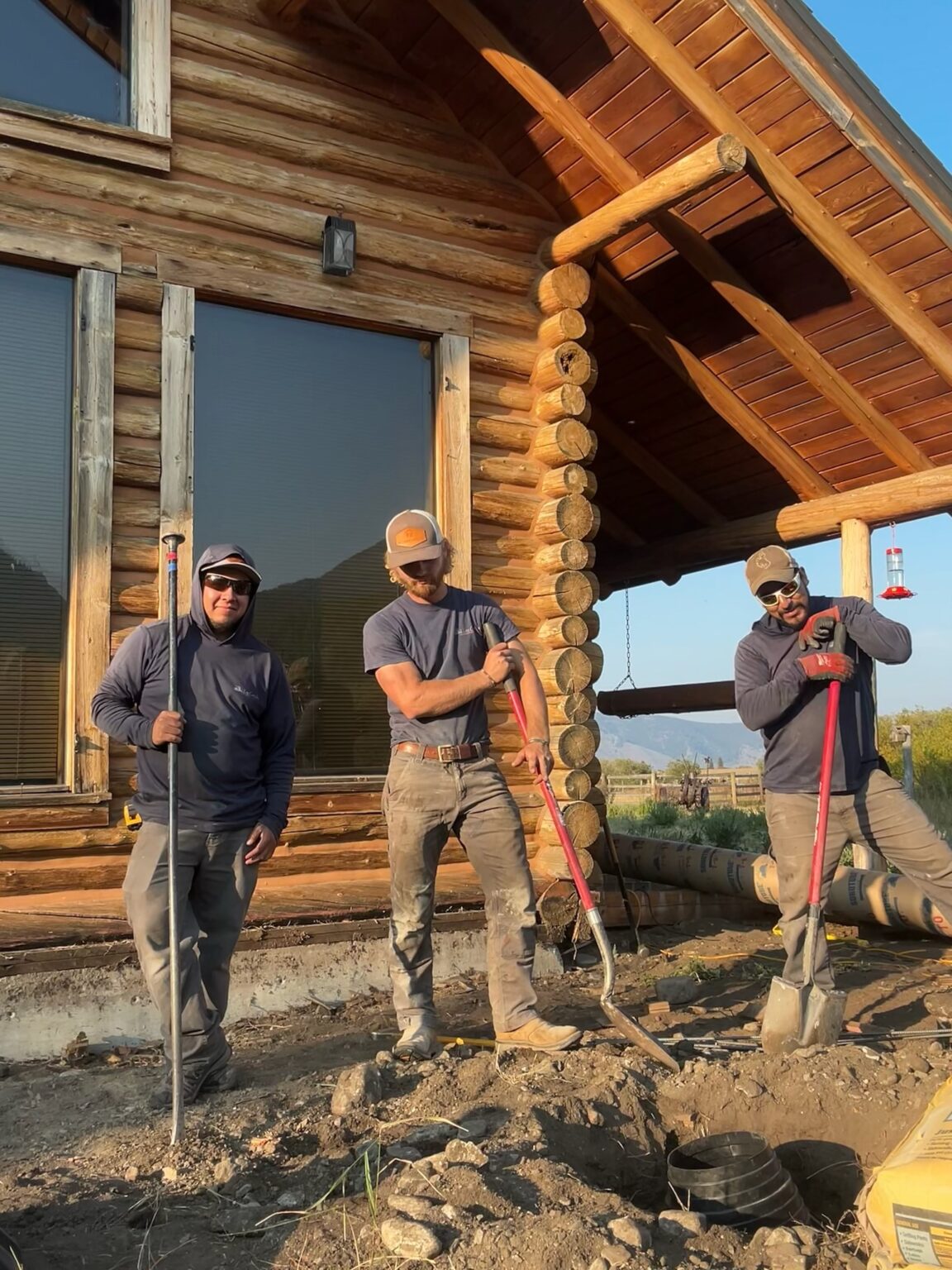
A log wall is a stack. Take one member out without supporting what is above it and you have a structural problem instead of a rot problem. Every replacement we do is shored first, cut second.
- 01
Assessment and scope
Probe, meter, scan, and mark the true edge of the damage. You get the extent in writing before a saw comes out, including what we found for the water source.
- 02
Shoring
The wall above the repair is supported on temporary posts and needle beams so the load never rests on the log being removed. On sill work this means jacking, done slowly and evenly across the span.
- 03
Cut back to sound wood
Cuts land in wood that resists a probe, not at the edge of the discolouration. Where the damage runs into a notch, the cut goes past the notch.
- 04
Match and set the new timber
Species, diameter, profile and moisture content matched to the existing wall. Contact surfaces and end grain are treated with borate before the log goes in, because the inside of a joint is the one place you can never treat again.
- 05
Fix the source
Flashing, grade, gutter, overhang, deck attachment — whatever put water on that log gets corrected in the same visit. This is not an upsell; a repair without it has a known expiry date.
- 06
What it costs
What log home repair costs in Teton County
Most log home repair projects in Jackson Hole and Teton Valley land between $6,000 and $40,000. The spread is that wide because a Dutchman patch and a jacked sill replacement are different trades wearing the same name.
- Borate treatment$1.50 – $3.00 / sq ft
- Epoxy consolidation, small areas$45 – $95 / linear ft
- Dutchman patch$250 – $700 each
- Half-log / facing replacement$65 – $130 / linear ft
- Full log replacement, non-structural course$1,200 – $2,800 per log
- Full sill log replacement, jacked$2,400 – $5,500 per log
- Most complete projects$6,000 – $40,000
Ranges are typical for Teton County and Teton Valley. Every log home is priced from a site visit, because access, wall height, log condition and the finish coming off change the number.
Three things move a quote more than anything else: access (a second-storey log over a deck costs multiples of the same log at grade), how far the rot travelled into the notch, and whether the water source is a $200 flashing fix or a roofline problem. We price those separately so you can see what you are actually paying for.
Find out how far it actually goes
A free on-site assessment gets you a probed, metered and scanned report of what is sound and what is not — in writing, with the water source identified. No obligation, and no number invented before we have looked.
Questions we get asked
Log home repair questions
How do I know if my logs are rotten or just weathered?
Weathered logs are gray and rough on the surface but still hard. Push a screwdriver or awl into the wood with moderate pressure — if it stops within a couple of millimetres, the log is sound and you are looking at a finish problem, not a log home repair problem. If the tool sinks in easily, or comes out with wet fibrous material, the wood has lost structural integrity and needs to be cut out.
Can rotten logs be repaired instead of replaced?
Often, yes. If the damage is under roughly a third of the log diameter and the log is not carrying a point load, a Dutchman patch or a half-log facing replacement is the correct repair. Once rot reaches the notch, passes through to the interior face, or affects a sill log, the log has to come out. The deciding factor is depth and load, not cost.
What does log home repair cost in Jackson Hole?
Most projects run $6,000 to $40,000. Individual repairs range from about $250 for a Dutchman patch to $2,400–$5,500 for a jacked sill log replacement. Access drives the number as hard as the rot does — the same log is far more expensive at second-storey height over a deck than at grade.
Is epoxy a real fix for log rot?
On shallow, contained, non-structural damage it is a legitimate repair. On a structural log it is not. Epoxy is harder than the wood around it, it does not move seasonally the way wood does, and it seals moisture behind a shell that looks sound. Most of the failed repairs we are called to undo in Teton County are epoxy used where wood should have been cut out.
How long does a log replacement take?
A single non-structural log is usually a one to two day job. A jacked sill log takes longer because shoring and jacking are done slowly and the wall has to be re-levelled. A full elevation with several courses affected typically runs one to three weeks depending on access and how much carpentry the water source repair involves.
Will the repair be visible afterwards?
Not from any normal viewing distance, if the new timber is matched properly and the finish is blended. A replacement log is new wood next to wood that has been on the wall for decades, so the two will not take stain identically on day one. They come together as the new log weathers. We match species, diameter and profile specifically so this closes quickly.
Keep reading
Related services
Log Home Media Blasting
Stripping failed stain and UV-grayed fiber back to bare, bondable wood — the step before any finish goes on a repaired wall.
Media blasting →Chinking & Caulking
Rebuilding the joints so the wall sheds water instead of holding it. Failed chinking is the most common reason a log rots in the first place.
Chinking & caulking →Thermal Imaging
Finding saturated wood, voids and air leaks behind trim and flashing — before a repair is scoped rather than after.
Thermal imaging →Log Home Staining
The finish that goes back on after the repair — matched and blended so the new logs do not read as a patch.
Log home staining →