
Carpentry on a moving structure · Teton County
Log Home Carpentry in Jackson Hole and Teton Valley
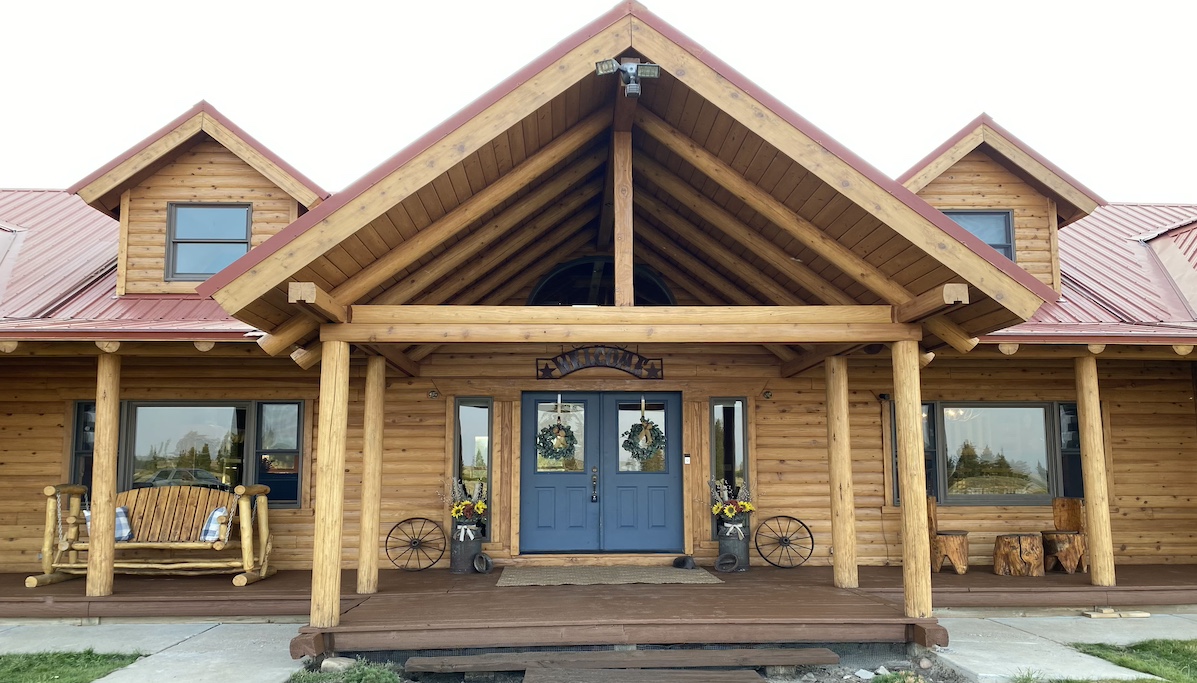
A log home moves. The walls shrink and drop for years while the posts holding up your porch roof stay exactly the same height. Carpentry that ignores that will bind, crack and pull apart. We build rails, decks, stairs and trim that expect the movement.
- Incorporated in Wyoming, June 2008
- Idaho registration RCE-35328, active
- BBB accredited, A+ rating
- Log homes are our only business
The short answer
What makes carpentry on a log home different?
Log home carpentry is carpentry built to move. A log wall shrinks as it dries and can drop half an inch per foot of height, while vertical posts and framed walls barely change. Rails, decks, stairs, ceilings and trim must be attached with slip joints and adjustable jacks so the wall can settle without tearing them apart.
The reason is grain direction. Wood shrinks six to ten percent across the grain and almost nothing along it, roughly a tenth of one percent. Stack twenty logs and the wall loses real height. Stand a post next to it and the post loses nothing. Everything you attach spans that difference.
Most of the movement happens in the first two heating seasons, but a handcrafted wall keeps creeping for years. An older home is not done moving. It is moving slower. Log Care builds to that, because log homes are the only structures we work on.
Signs it is failing
How to tell the carpentry on your log home is failing
Bad log home carpentry announces itself the same way every time. Something binds, something cracks, or something pulls away from the wall. The damage shows up two to five years after the work, long after the carpenter has gone.
Doors and windows that bind
A settling wall bearing down on a window frame is the classic symptom. The opening loses height, the sash stops closing, and the glass starts carrying load it was never meant to carry. The fix is at the header, not the hinge. Planing the door edge buys a season and solves nothing.
Cracked drywall along log walls
Drywall framed tight to a log wall has nowhere to go. The logs drop, the studs do not, and the seam tears, usually in the same corner every year. Taping it again is not a repair. The wall needs a slip connection so the logs can move behind the finish.
Rot at railing post bases
Log rails fail at the bottom of the post and the top of the newel. Both are end grain. End grain drinks water like a straw, and a flat-cut post top holds a puddle after every storm. Look for dark, soft wood at the deck surface and spongy bottom rails around the spindles.
A post that stopped carrying
Vertical posts under a porch roof or loft beam do not shrink, but the log wall next to them does. If the post was set without an adjustable jack, the wall drops away and the post ends up taking load the wall used to share. Look for crushed fibers at the post top.
Gaps at trim and ceilings
Trim should be fastened at the top of the settlement space only, so it slides as the wall drops. Fastened top and bottom, it splits or opens a gap you can see daylight through. The same goes for tongue-and-groove ceilings that die into a settling gable wall.
Soft rafter tails and fascia
Exposed rafter tails take the first hit from roof runoff and splashback, and the cut ends are end grain again. Probe them. If a screwdriver sinks in, the rot is usually further back than it looks. Fascia and soffit go the same way, quietly, behind paint that still looks fine.
How we build it
How carpentry gets done on a structure that is still moving
Every connection between something rigid and a log wall needs a plan for movement. We measure what the wall has already done, work out what it has left, then detail each joint to absorb it. The carpentry is ordinary. The connections are not.
- 01
Measure the settlement first
Before anything gets built, we find out how much the wall has already dropped and how much is left. Log species, wall height, age and moisture content all matter. A wall built from green logs three years ago has a very different budget of remaining movement than one that has been standing since the eighties.
- 02
Set posts on adjustable jacks
Any post carrying load next to a log wall gets a screw jack, top or bottom, hidden in the detail. As the wall settles, the post gets shortened to match. New construction typically needs adjustment at six to twelve months, again after a second heating season, sometimes a third. They get set so they can actually be reached.
- 03
Slip joints at every framed wall
Where framing meets logs, the connection is a vertical slot with a lag and washer, not a fixed screw. The framed wall holds its position while the log wall slides past it. Kitchen cabinets get hung on that framing, never on the logs directly, so the boxes stay level as the wall comes down.
- 04
Bucks and settlement space at openings
Windows and doors go into bucks that let the log ends slide in a vertical channel. Above the unit there is a settlement gap sized to the wall’s remaining movement, packed with insulation that compresses instead of resisting. Trim is fastened at the top of that gap only, so it never has to come off for an adjustment.
- 05
Build rails and decks to shed water
Rot prevention is a carpentry decision, not a stain decision. Post tops get capped or cut to drain. Bottom rails get weep holes drilled up from below so water that wicks down a spindle has somewhere to go. Posts sit on stand-offs that hold the end grain above the deck surface with air moving underneath.
- 06
Cut back to sound wood
On rafter tails, posts and beams, the load gets shored first, then the cut goes past the rot until the blade is in clean wood. A sistered or scarfed repair has to reach well back into the sound member to carry the load. For a two-foot overhang, that means several feet. Patching the visible inch is how it comes back.
What it costs
Log home carpentry costs in Teton County and Teton Valley
Most log home carpentry in this valley lands between $3,500 and $45,000. A railing section is at the low end. A full deck rebuild with new posts and a custom stair is at the top. Labor here runs well above national rates, and materials ship in.
Typical ranges, Teton County and Teton Valley
- Log railing rebuild, per linear foot$85 – $225
- Deck rebuild on a log home, per square foot$75 – $150
- Structural log post replacement, each$1,200 – $4,500
- Rafter tail repair, each$450 – $1,400
- Tongue-and-groove ceiling, per square foot$12 – $26
- Custom log stair, complete$9,000 – $30,000
The cheap bid is cheap because it skips the connection details. Fixed screws instead of slotted ones. No jack under the post. Trim nailed top and bottom. The work looks identical the day it is finished. Three winters later the wall has moved and you are paying someone to take it apart.
Have a log carpenter look first
Call Log Care at 307-734-9563. We work out of Victor, Idaho and cover Jackson, Wilson, Teton Village, Driggs, Star Valley and the valleys between. Send photos of the problem and we will tell you what we see.
Questions we get asked
Log home carpentry questions
Can a regular carpenter work on my log home?
A skilled carpenter can cut and fit anything. The risk is the connections. A log wall moves and a framed wall does not, so any joint between them has to slide. Carpenters who build on stick-framed houses reasonably assume the wall stays put, and they fasten accordingly. That assumption is what binds doors, cracks drywall and splits trim two or three winters later. Ask any bidder how they plan to handle settlement.
My log home is forty years old. Is it still settling?
Probably, but slowly. The bulk of shrinkage happens in the first year or two as the logs reach equilibrium with the climate. After that the wall keeps responding to seasonal humidity, and compression under load continues for decades. An older wall is more stable, not static. Detailing still matters, though the settlement gaps you need are smaller than on a new build.
How much does a log wall actually drop?
It depends on how the home was built and how wet the logs were. Handcrafted homes built from green logs are commonly designed for several inches of settlement over the life of the wall, and up to half an inch per foot of wall height is a documented figure. Kiln-dried milled log walls move far less, often an inch or so. Your home needs measuring, not a rule of thumb.
Can you repair a log railing, or does the whole thing come out?
Often it is partial. Rot in log rails concentrates at post bases, post tops and the spindle holes in the bottom rail, so a section can frequently be rebuilt while sound posts stay. What forces a full replacement is structural: posts that have lost bearing, or a system built without drainage details that is failing everywhere at once. We look before quoting.
Do you work on absentee properties?
This is normal in Jackson Hole and Teton Valley. Many owners are out of state and the first call comes from a caretaker or property manager. Photos and measurements travel well for scoping, but a log structure has to be seen in person before anyone commits to a number. Approvals come from another state all the time. They just should not come without someone standing at the wall.
Will new carpentry match the existing logs?
Matching is a species, profile and finish question. New material will not have the patina of a wall that has been in the sun for thirty years, and stain closes some of that gap but not all of it. On rails and stairs the profile and joinery matter more than color, because those read as shape from a distance. We discuss the match before ordering material.
Keep reading
Related services
Log Rot & Replacement
When carpentry uncovers rot in a wall log, the log itself has to be cut out and replaced.
Read moreStaining & Refinishing
New carpentry needs finish before weather reaches it. Bare end grain on a new rail fails first.
Read moreChinking & Caulking
Settlement opens joints. Chinking has to flex with the wall or it tears at the log.
Read more